" height="213.6478159895544px" id="mlUOg__yb" width="668.0000143938418px"/></svg>)
Pair. Learn. Autonomy.
News
We started Yaak with a stubborn belief: Intelligence for the physical world must come from the physical world, not from simulators, not from lab environments, and not from world models trained with a bottomless pit of compute.
So we did the unglamorous thing: we went and got the data.
That belief has led us down contrarian paths:
We built a Spatial Intelligence Kit (SIK) that can be paired with any physical asset to collect multimodal robotics data.
We deployed SIK on class B vehicles across German driving schools and collected expert-policies at petabyte scale and crafted our hardware for reliability across hundred of thousands of kilometers.
We built efficient robotics foundation models that can be trained with only a handful of GPUs and can actuate the physical asset through SIK (on-edge).
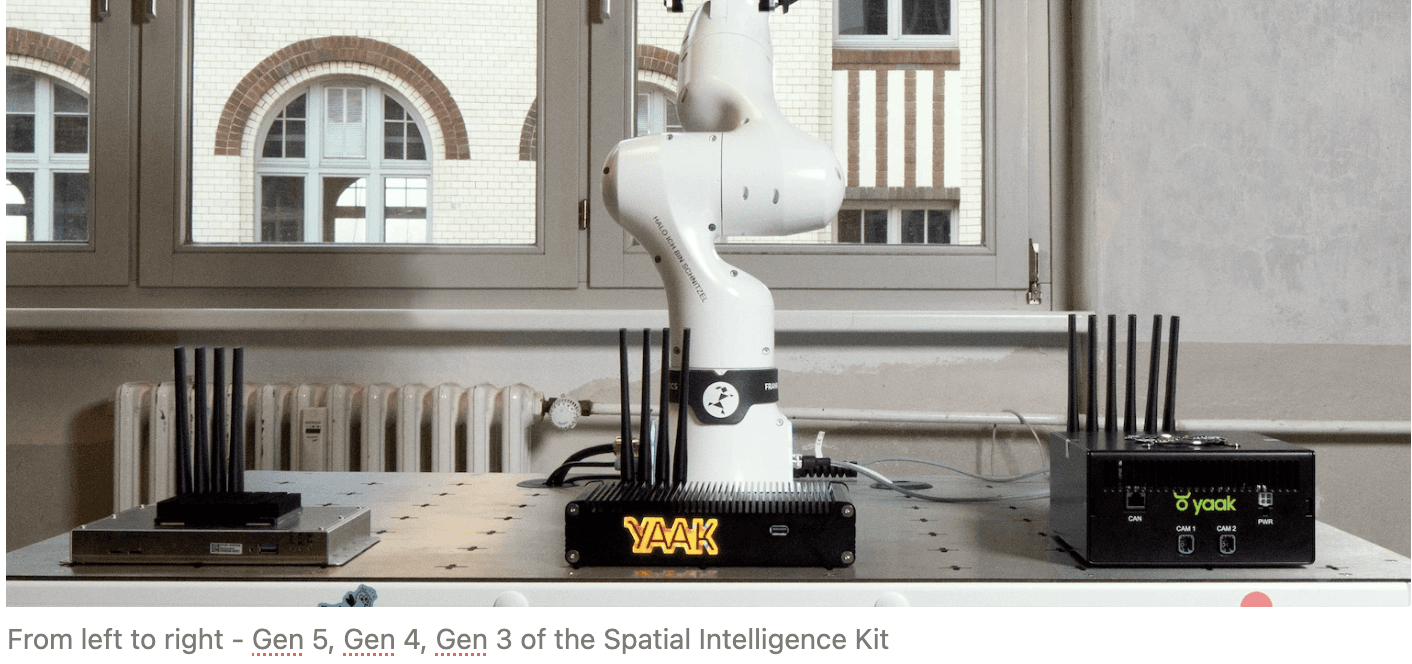
Where it got us: Yaak is the curator of the world’s largest open-source autonomous driving dataset (L2D); and builder of a full-stack physical AI platform that works with your existing fleet today by simply pairing your physical asset with SIK.
Why a Spatial Intelligence Kit? Why design SIK to be embodiment agnostic? Why robotics AI on-edge?

Three convictions
Lab ≠ Market. Data from clean, structured environments and simulation rarely overlaps with target environments where the physical asset are deployed. A policy that scores high on offline benchmarks can degrade during an out of distribution work shift.
SIK is designed to be embodiment agnostic and can be easily paired with any physical asset to source multimodal data right from the target environment and safely actuate the asset.
Demos ≠ Deployments. Social media clips don’t line up with reality. A continuously operating fleet (data collection and autonomy) requires maturing the entire physical AI stack and continuously crafting it for reliability in the field, in collaboration with asset owners.
Today Spatial Intelligence Kit is forward deployed on multiple types of physical assets (class B vehicles, Pallet jacks, Forklifts, robotics arms) in the field.
Cloud ≠ Actuation. Robotics control loops run at 10-100 Hz. State-of-the art Billion+ parameter model require server grade GPUs in the cloud, a harsh latency and connectivity requirement that come along with it. To satisfy the high frequency control loop requirement, robotics AI has to run on the embodiment, next to the sensors, within limited power and compute budget.
Our efficient foundation model (rmind zero) runs on SIK at the edge to actuate the physical asset with no dependency of real time connectivity.
1.- 3. has lead to an ever widening gap between between robotics labs and real-world deployment. Frontier models can manipulate novel objects, show generalization across tasks on benchmarks, and operate with minimal human supervision in labs. The story doesn’t hold in warehouses, factories, quarries and truck yards which have minimal overlap with the data used for training the AI.
Today’s “replace the fleet” or “rebuild the physical asset” approach to physical AI forces write-offs of existing physical assets and creates major operational disruptions during integration. Yaak has a different premise: Work with the hardware you already own and make your hardware work.
Pair. Learn. Autonomy.
Our Spatial Intelligence Kit (SIK) pairs with any physical asset in a couple of hours. Be that a pallet jack, forklift, wheel loader, street sweeper or a car. SIK learns in the background during daily operations. The existing fleet becomes the hardware foundation, what changes is the intelligence.

Your hardware, hard at work.
With SIK, the physical assets generate data continuously. That data is the record of operations and actuation of the physical asset. Next we extract spatial intelligence from it. Every pallet jack in the warehouse improves the model for every other pallet jack. Every successful pick, every recovered failure and recovery, and every environmental variation becomes training material for our efficient foundation models.
Our efficient robotics AI is deployed back on the SIK and the asset joins the fleet as an autonomous agent. This is how we close the deployment gap: not by making robots smarter in the labs, but by making deployment itself feed the learning flywheel.
Yaak transforms physical assets into autonomous workers. If you're running a fleet of pallet jacks, forklifts, wheel loaders, street sweepers and you’re ready to explore autonomous operations, let's talk.